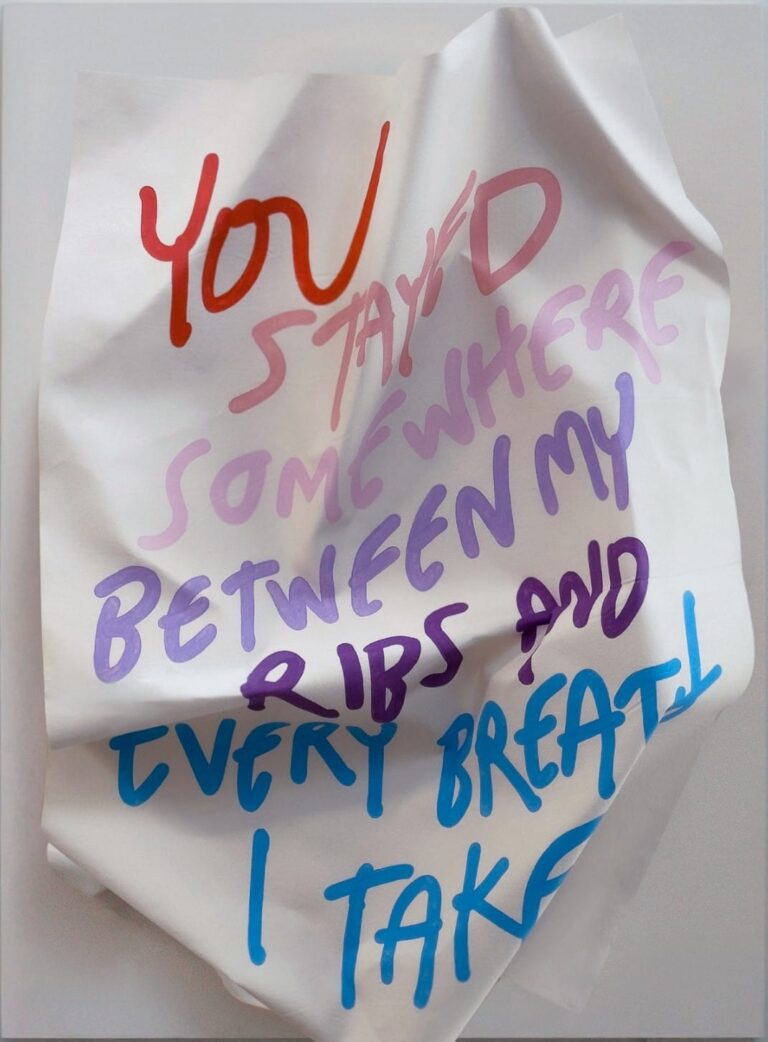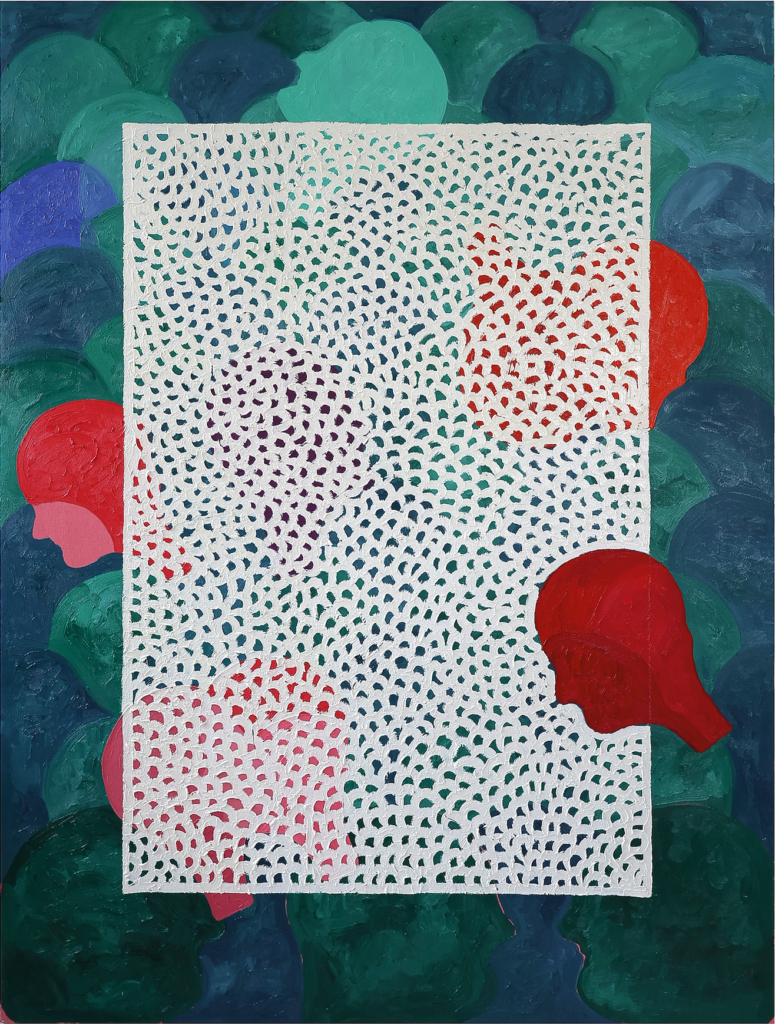
Francisco Gonce is an abstract painter from Mérida, Yucatán, born in 2000, whose canvases work as a record of inner life. Painting mainly through abstract expressionism in oil and oil pastel, he lets shapes lead the composition and gives them new meaning along the way, so each work reads as autobiography written in colour and gesture rather than in pictures.
His two large 2025 canvases currently available at Art of NOMA, After Dark and Uncertain Smile, show that approach at full scale. This spotlight looks at where the work comes from, how he builds a surface, and what a collector is actually bringing home with one of these paintings.

A young painter from Mérida working in abstraction
Gonce was born in Mérida, the capital of Yucatán, in 2000, and is currently studying architecture at the Marist University. His painting therefore develops alongside a training that is all about space, structure and how people move through a room.

It would be easy to look for architecture in his canvases and find it everywhere. The more honest reading is simpler. His paintings are not plans or buildings. They are fields of colour and mark where a few strong shapes carry the weight, and those shapes are chosen with the care of someone who thinks about form for a living.
For a collector, the useful point is timing. A painter at the start of a career, still studying and already working at a scale of more than a metre and a half, is building a body of work in real time. Owning one of these early canvases means owning part of that beginning.
How a physical limitation became a way of seeing
His artist page is direct about where the work comes from. It says his painting was born from a physical limitation that keeps him from exploring the world around him as he would like, so he puts his thoughts and desires on canvas instead. The painting becomes the place where that exploring happens.
That origin explains why the work turns inward. These are not views of places he has been. They are closer to states he has lived through: moods, memories and wishes given colour and shape. The canvas works as a room of its own, somewhere the painter can go without leaving.
It also explains the intensity. When a painting carries that much of what its maker wants to say, the surface tends to be worked and reworked, and the result feels charged rather than decorative. That is the quality most people notice first when they stand in front of a Gonce.
What does abstract expressionism mean in his work?
Abstract expressionism is the name usually given to painting where gesture, colour and the physical act of making the mark carry the meaning, rather than a recognisable subject. The term is most closely tied to painters working in New York in the 1940s and 1950s, but it has long since become a living way of working for artists everywhere.
Gonce’s artist page describes how he uses it. He allows certain shapes to guide the work, then gives those shapes new meaning as the painting develops, so the composition grows out of the forms rather than being planned in advance. A shape that begins as a mark can end up as the emotional centre of the canvas.
The page also calls the work autobiographical, in two specific ways: the forms he chooses and the colour palettes he selects, both shaped mainly by his childhood and adolescence. If you are new to reading this kind of painting, our guide to the emotional language of abstract painting is a good companion, and our list of abstract painters to watch shows how other artists on the site approach the same territory.
After Dark and the idea of interior weather
The gallery’s description of After Dark uses a phrase that fits his whole practice: interior weather. Atmosphere and emotional intensity come before description. The darkness in the title is a mood and a psychological state rather than a literal night, the point where visibility softens and what is happening inside comes forward.
The surface carries that idea. Rich, layered oil sits against the visible gesture of oil pastel, and the painting stays deliberately unresolved, density meeting softness. The description names the tension that runs through his work as the fragile line between expression and restraint, and After Dark holds that line across the whole canvas.
At this size it is a painting for slow looking. It does not give everything away from the doorway. It rewards standing with it at different times of day, which is exactly what living with a work of this scale allows.
Uncertain Smile, between expression and concealment
Uncertain Smile takes the same tension and turns it towards the face, or at least towards the idea of an expression. Its description calls it an expression suspended between clarity and doubt, a work that resists easy reading and deals with subtle emotional shifts rather than fixing a story in place.
The title does a lot of work. A smile is usually the most readable expression there is. Making it uncertain asks the viewer to notice everything a smile can hide, and the painting answers with saturation and gesture side by side, oil for depth and pastel for texture and immediacy, a surface that the gallery describes as both deliberate and vulnerable.
Its vertical format matters too. At 162 × 125 cm the canvas sits close to human scale, so standing in front of it feels less like looking at a picture and more like facing someone. Certainty and hesitation overlap across the surface, and that is the point.
Why combine oil paint with oil pastel?
Both available works are oil and oil pastel on canvas, and the pairing is a large part of how they look. Oil paint can be built up in layers, glazed and blended, which gives depth and a rich, saturated colour. Oil pastel is pigment held in oil and wax in stick form, applied directly by hand, so it leaves a visible, textured line that keeps the energy of the moment it was drawn.
Used together, they let a painting be slow and fast at once. The oil holds the atmosphere, the pastel records the gesture on top of it. In Gonce’s canvases you can often see where one ends and the other begins, and that visible meeting is part of the work’s honesty.
Each canvas is a unique original, stretched on a professional wooden frame, and comes with a certificate of authenticity. Our note on what a certificate of authenticity means for collectors explains what that document should record and why to keep it with the work.
Living with a large abstract canvas at home
At 162 × 125 cm, either painting will anchor a wall on its own. It suits a living room, a stair landing or a long dining wall, anywhere you can step back a few metres and take in the whole field of colour before moving close to see the pastel marks. Our guide on choosing the right size art for your wall walks through the proportions.
Light is worth planning for. A layered oil surface with pastel on top changes noticeably between morning and evening, and a painting called After Dark will feel different by lamplight than in daylight. Our piece on how light changes a painting throughout the day explains what to look for before you choose a wall.
Above all, these are paintings to live with rather than to decode. Gonce is painting what he cannot always go out and find, and the canvases leave room for whoever owns them to bring their own weather. You can see both available works, and the rest of his body of work, on the Francisco Gonce artist page.
Frequently Asked Questions
Who is Francisco Gonce?
Francisco Gonce is an abstract painter born in Mérida, Yucatán, in 2000, who is currently studying architecture at the Marist University. He works mainly through abstract expressionism in oil and oil pastel on canvas.
What is Francisco Gonce’s work about?
His work is autobiographical. It was born from a physical limitation that keeps him from exploring the world as he would like, so he puts his thoughts and desires on canvas. His forms and colour palettes are shaped mainly by his childhood and adolescence.
What materials does Francisco Gonce use?
The two works available at Art of NOMA, After Dark and Uncertain Smile, are oil and oil pastel on canvas from 2025. Each measures 162 × 125 cm, is a unique original stretched on a professional wooden frame and comes with a certificate of authenticity.
Where can I see Francisco Gonce’s paintings?
His available works are listed on the Francisco Gonce artist page at Art of NOMA, where each painting has its own page with details, dimensions and current availability.