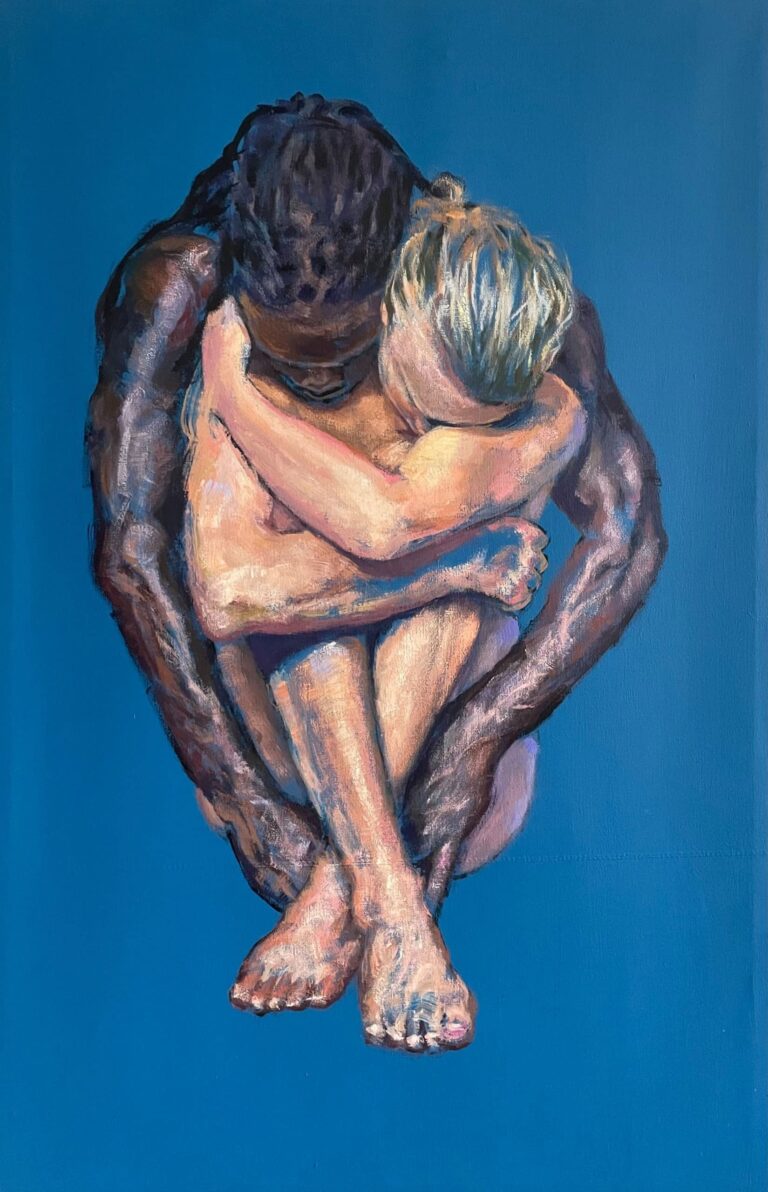
Contemporary surrealism is art made now that keeps Surrealism’s interest in dreams, the unconscious and the uncanny, while leaving behind most of the original movement’s methods. The movement itself was defined by André Breton in 1924 as “pure psychic automatism”; today’s painters usually work slowly and deliberately, in oil, and aim for the same strangeness by other routes. This guide sets out the difference and introduces five artists on the Art of NOMA roster whose work belongs in the conversation.
Key takeaways
- Surrealism was named by Guillaume Apollinaire in 1917 and defined by André Breton in his 1924 manifesto as “pure psychic automatism”, according to Tate.
- Contemporary surrealism keeps the dream, the symbol and the uncanny, but most of today’s painters build their images deliberately rather than through automatic methods.
- Aurora Kalos, Mónica Loya, Arturo Lemus Beltrán, Niamh Barry and Daniel Stara each work in a surreal register, with different subjects: portraiture, pop surrealism, the posthuman, office life and landscape.
- Tate describes the uncanny as the familiar made alien, which is a useful test when you look at any surreal painting.
- On 3 November 2026 the lowest-priced work in the Art of NOMA catalogue is MX$2,356, so collecting in this field does not start with a large budget.
- Each painting discussed here is listed with a certificate of authenticity on its work page.
What exactly is contemporary surrealism today?
The short answer is that it is surrealism without the manifesto. Tate describes the original movement as a twentieth-century literary, philosophical and artistic current that explored the workings of the mind and championed the irrational and the poetic. It balances a rational view of life with one that asserts the power of the unconscious and dreams. Contemporary surrealism takes that balance as a starting point and asks what it looks like in a present that is saturated with screens, feeds and images.

The word itself is older than the movement. Tate credits the poet Guillaume Apollinaire with coining “surrealist”, in the preface to a play performed in 1917, and André Breton with defining it in the Surrealist Manifesto of 1924. Breton described it as the dictation of thought in the absence of all control exercised by reason. That sentence is the dividing line. The artists below do not usually claim to paint without reason, but they do share the movement’s wish to put the hidden, the strange and the half-remembered on a canvas.
A practical test helps. If a painting is dreamlike but also carefully constructed, if it uses recognisable things in places where they do not belong, and if it leaves you slightly unsettled rather than simply decorated, it is probably working in the surreal register. That is a looser definition than a museum would use, but it is the one that fits most of the painting being made today.

How does it differ from the original movement?
The original Surrealists were interested in method as much as image. Tate’s page on automatism explains that Breton and others produced the earliest examples in automatic writing, and that Max Ernst invented surrealist collage, which Tate calls the first form of automatism in visual art. Ernst also used frottage, or rubbing, and grattage, or scraping, to create chance textures. Joan Miró and André Masson developed automatic drawing and painting as well. Chance was the tool.
Most contemporary painters in this field reverse that order. They plan the picture, stage the figures and finish the surface with care. The strangeness comes from the subject and the juxtaposition rather than from a technique that bypasses the hand. The table below sets the two approaches side by side, using Tate’s description of the historical movement and the artists’ own pages on our site for the contemporary column.
| Feature | Historical Surrealism | Contemporary surrealism at Art of NOMA |
|---|---|---|
| Starting point | Breton’s 1924 manifesto, “pure psychic automatism” | The dream, the symbol and the uncanny, without the manifesto |
| Method | Automatic drawing and writing, collage, frottage, grattage | Planned compositions, mostly in oil |
| Subject | Dream worlds and hidden psychological tensions | Portraiture, domestic scenes, the posthuman, office life, landscape |
| Feeling | Liberation of the mind, in many cases political freedom | Melancholy, anxiety, suspense and unease |
Not everything changes. Tate notes that surrealist artists drew on mysticism, ancient cultures and Indigenous art, and that the movement’s ideas travelled through international networks and were adapted to different places. That is still true. The five artists below were born in Ukraine, Mexico, the United Kingdom and the United States, and they now work in different countries.
Which contemporary surrealist artists should you know?
All five artists below are on our roster, and every fact about them comes from their own pages on artofnoma.com. They are not a ranking and they do not form a school. What they share is a way of making the ordinary slightly impossible.
Aurora Kalos: portraits at the edge of dream
Aurora Kalos was born in Odessa, Ukraine, in 2001 and is currently based in Germany. She graduated from one of the oldest art institutions in Ukraine and, according to her artist page, works in the field of surrealism with a focus on portraiture, exploring the complexity of the female soul, its tenderness and strength, vulnerability and inner resilience.
Her oil painting Awakening, from 2026, measures 120 × 80 cm and shows a figure caught mid-transformation, between states. The threshold between dream and waking is the subject outright. Our longer profile, Aurora Kalos and the search for home, follows the same thread.
Mónica Loya: pop surrealism and quiet melancholy
Mónica Loya was born in Chihuahua, Mexico, in 1990. Her artist page describes her work as falling within pop surrealism, exploring the human figure, mostly female, and emotions such as anxiety, melancholy and desire. She combines everyday scenes with dreamlike atmospheres, using soft palettes and compositions that hold a tension between the intimate and the unsettling.
La Espera is an oil on fabric from 2025. The title means “the wait”, and the painting holds anticipation in suspension: bright, flattened colour set against a mood of stillness, with familiar domestic elements drifting slightly out of logic. It is a good first example of how the pop palette and the uncanny can sit together.
Arturo Lemus Beltrán: old-master realism meets the machine
Arturo Lemus Beltrán was born in Chimalhuacán, Mexico, in 1978. His page describes work that explores the tensions between the human, the social and the posthuman, and notes more than 100 group exhibitions in museums, universities and cultural forums in Mexico and abroad, including Canada, Cuba, the United Kingdom, Spain and Germany.
El Fruto del Nuevo Edén (2023, 120 × 180 cm) stages the encounter between classical technique and the machine age. It uses the language of old-master realism, with smooth modelling and controlled light, and then lets reflection and digital rupture disturb it. The unease is built into the precision: the more real it looks, the stranger it reads. The title reframes an old myth as a contemporary question about technology and the self.
Niamh Barry: the strange side of the office
Niamh Barry was born in London in 1996, is a Canadian painter based in London, and works mainly in oil on canvas. Her figurative paintings examine loneliness, anonymity and escapism in modern professional life, drawing on seven years she spent on the investment team of a major North American growth-equity fund.
The Long Soak (2026, oil and acrylic on canvas, 121.9 × 121.9 cm) shows an anonymous figure attempting to detach from the demands of work, with stillness becoming a subtle form of escape. Nothing is overtly impossible, which is exactly why it reads as surreal. Our profile, The quiet behind the polished surface, goes further.
Daniel Stara: landscapes that hold their breath
Daniel Stara was born in 2000 in Florida. His artist page calls him renowned for surreal landscapes that merge classical imagery with post-apocalyptic motifs, rendered in an expressive, impressionistic style that evokes a sense of dystopian wonder.
For My Next Trick (2025, oil on canvas, 116 × 175 cm) is a broad horizontal canvas built through slow transitions and restrained colour. The title marks a pause, the charged interval before a revelation, and the painting stays inside that suspense rather than resolving it. We wrote about his preoccupation with surveillance in paintings about being watched.
Why does surrealism feel current now?
A century after the manifesto, a large share of ordinary life happens through screens and systems that most of us do not fully understand. Images arrive without a source, faces appear that belong to no one, and a feed can move from the trivial to the alarming in a single swipe. It is not hard to see why artists reach again for a tradition that was built to describe a mind pulled between the familiar and the strange.
This is our reading rather than a measured trend, and the artists above would not all agree with it. Lemus Beltrán engages technology directly. Barry looks at work and rest. Loya and Kalos stay close to emotion and the figure. What they share is a refusal to explain. A surreal painting rarely tells you what it means, and many collectors find that open question is what keeps a work interesting on the wall over the years.
How do you look at a surreal painting?
Start with what is familiar. Tate’s page on the uncanny traces the idea to Freud’s 1919 essay, which described something that is familiar and yet alien at the same time, and notes that artists associated with Surrealism combined familiar things in unexpected ways to produce that feeling. In practice, that means asking which element in the picture you recognise at once and which one will not stay put.
Then look at the handling. Lemus Beltrán uses controlled, realistic modelling so that the disturbance reads as more convincing. Stara lets surfaces accumulate slowly so that a landscape feels paused. Loya flattens colour so that a domestic scene feels like a memory. Technique is not decoration here, it is part of how the strangeness is delivered.
Finally, notice what is withheld. Barry’s figures are anonymous, Kalos’s women sit between states, and Stara’s titles stop at the threshold of a revelation. A good surreal painting leaves a gap, and the gap is where you do some of the work. If you want a route into looking more broadly, our guide to emerging art in Mexico City sets out where to start.
What should you ask before buying one?
The questions are the same as for any original painting. Ask about the medium, the date, the size and the materials. Ask who owned the work before you and whether a certificate of authenticity comes with it. The work pages for the paintings in this guide list oil or oil and acrylic, the year, the dimensions, that each is a unique work, and that a certificate of authenticity is included.
On price, we can be exact about one thing only. On 3 November 2026 the lowest-priced work in the Art of NOMA catalogue is MX$2,356. Original paintings sit well above that and rise with size, medium and the artist’s exhibition history, so check each work page for its current price rather than relying on a guide. Prices and availability change.
Where can you see more of this work?
Begin with the artists themselves. Each of the five has a page on our site with their full body of work: Kalos, Loya, Lemus Beltrán, Barry and Stara. You can also meet all of our artists and browse the full catalogue of works.
If you would like to see a painting before deciding, contact the gallery and ask about viewing options. A surreal picture often changes in person, because scale, surface and light carry so much of the mood.
Frequently Asked Questions
What is contemporary surrealism?
Contemporary surrealism is art made today that keeps Surrealism’s interest in dreams, the unconscious and the uncanny, but usually works through planned compositions rather than the automatic methods of the original movement.
Is surrealism still made today?
Yes. Artists on the Art of NOMA roster, including Aurora Kalos, Mónica Loya, Arturo Lemus Beltrán, Niamh Barry and Daniel Stara, work in a surreal register, each with a different subject and technique.
How is contemporary surrealism different from Dalí and Magritte?
The original Surrealists, according to Tate, often used automatism and chance, such as automatic drawing, collage, frottage and grattage. Many contemporary painters instead plan the picture and build the strangeness through subject and juxtaposition.
How much does a surreal painting cost?
It depends on the artist, size and medium. On 3 November 2026 the lowest-priced work in the Art of NOMA catalogue is MX$2,356, and original paintings are priced above that. Check each work page for its current price.
Verified 3 November 2026 against Tate’s pages on Surrealism, automatism and the uncanny, the Art of NOMA artist and work pages, and the works catalogue.