Mexico’s federal law on monuments requires a permit to take an artistic or historical monument out of the country, and bans the export of archaeological monuments. The same law says that a movable work by a living artist cannot be declared an artistic monument. For a collector buying new work from a living artist, that is the key point, though older works and anything ancient need a separate check before they travel.
Key takeaways
- Article 16 of the Ley Federal sobre Monumentos y Zonas Arqueológicos, Artísticos e Históricos allows privately owned historical or artistic monuments to be exported, temporarily or permanently, with a permit from the competent institute.
- The same article prohibits exporting archaeological monuments, apart from exchanges or donations to foreign governments or scientific institutes by agreement of the President.
- Article 33 says movable works by living artists cannot be declared artistic monuments.
- Article 53 sets prison of five to twelve years for taking a monument out of the country without the institute’s permit.
- A proposal filed in the Chamber of Deputies on 8 April 2026 states that the regulation bars the permanent export of privately owned works officially declared monuments. We could not open the regulation itself.
- On 1 November 2026 the lowest-priced work in the Art of NOMA catalogue is a print at MX$2,349.

What does Mexican law actually regulate?
The rule most collectors hear about is the Ley Federal sobre Monumentos y Zonas Arqueológicos, Artísticos e Históricos, published in 1972. We read the version on the website of the Chamber of Deputies on 1 November 2026, which states that its latest reform was published on 14 November 2025. The law does not regulate “art” in general. It regulates three categories of monument: archaeological, historical and artistic.

Archaeological monuments are goods produced by cultures before the Hispanic culture was established in the national territory, along with related human, plant and animal remains. Article 27 makes movable and immovable archaeological monuments property of the Nation, inalienable and not subject to prescription. Artistic monuments are goods with relevant aesthetic value, judged by features such as representativeness, stylistic current, degree of innovation, materials and techniques.
Competence is divided. The Instituto Nacional de Antropología e Historia deals with archaeological and historical monuments, and the Instituto Nacional de Bellas Artes y Literatura deals with artistic ones. If a case is doubtful, the Secretary of Culture decides which institute handles it.
Are works by living artists covered?
Article 33 answers this directly: works by living artists that are movable goods cannot be declared artistic monuments. A painting made last year by an artist who is alive is therefore outside the artistic-monument category, and the export permit in Article 16 is written for monuments. Nothing in the law’s text requires such a permit for it.
That is a statement about this one law, not about every rule that touches a shipment. Taxes, customs declarations and the destination country’s import rules sit elsewhere, and we did not find a primary source in this research that sets them out for art. Our guide to buying art from abroad explains how shipping and duties usually work from the buyer’s side, and it is clear that the rules of your own country decide what you pay on arrival.
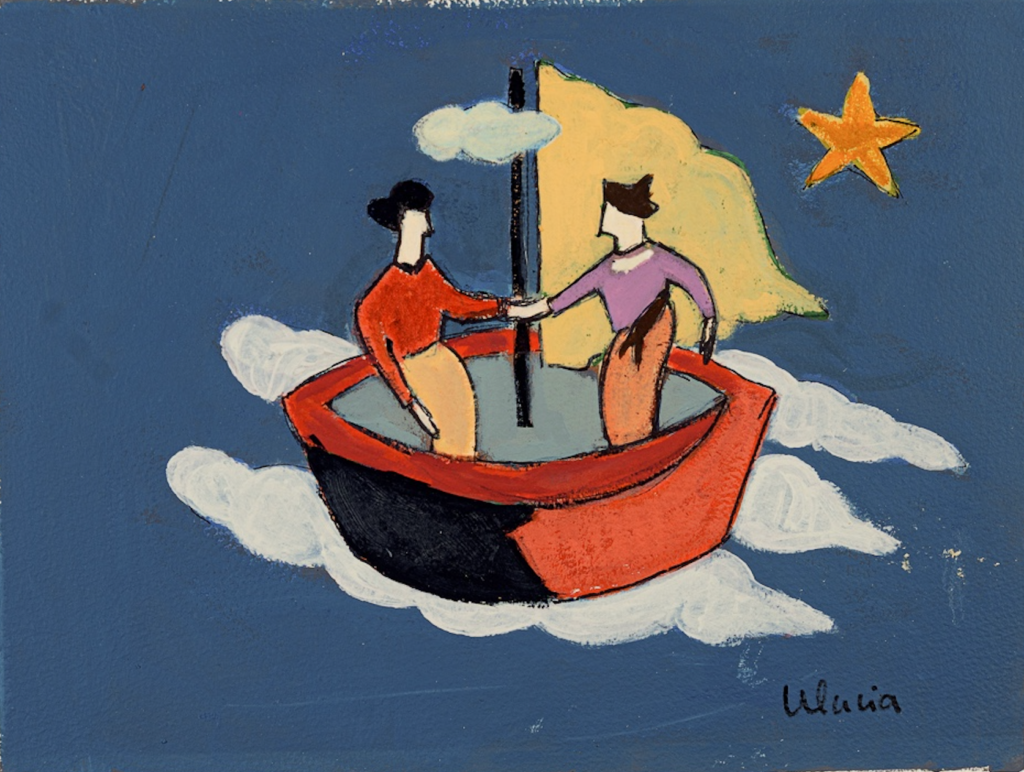
Everything at Art of NOMA is an original from a living artist represented by the gallery, and each work ships with a certificate of authenticity signed by the artist, according to the page of each work. As an example, Barca para Dos by Paloma Ulacia is a 22.5 × 30.5 cm painting listed at MX$25,831, and its page shows the same terms. A living artist’s work is the case the statute carves out from the monument regime.
What about older and archaeological pieces?
This is where the law bites. Article 16 prohibits exporting archaeological monuments. The only exceptions it names are exchanges or donations to foreign governments or scientific institutes, which the President of the Republic must agree. A private buyer cannot rely on that exception.
Historical monuments cover more ground than people expect. Article 36 lists, among others, furniture found in churches, convents and other buildings from the sixteenth to the nineteenth centuries that served religious, educational, charitable or public purposes, and relevant private civil works from that period. It also covers original manuscripts related to Mexican history, and books, pamphlets and other prints made in Mexico or abroad between the sixteenth and nineteenth centuries that are rare and important enough to be kept in the country.
For private historical or artistic monuments, Article 16 allows export, temporary or permanent, with the competent institute’s permit under the regulation. A proposal filed in the Chamber of Deputies on 8 April 2026, about the Gelman collection, describes the regulation as barring the permanent export of privately owned works officially declared monuments and the temporary export of those whose integrity could be harmed by transport. We quote it as a legislator’s account, because the regulation itself was not open to us. If you are considering a work by a deceased Mexican modernist, treat the permit question as a matter for the institute and a specialist lawyer.
Dealers have duties too. Article 15 says traders in monuments and in historical or artistic goods must register with the competent institute. A seller who deals in older material and cannot say whether it is registered or declared is a warning sign.
What happens if the rules are ignored?
Article 53 is blunt. Whoever tries to take, or takes, an archaeological, artistic or historical monument out of the country without the institute’s permit faces five to twelve years in prison and a fine of three thousand to five thousand days. Anyone who orders, induces, directs, organises or finances the act can face penalties increased by up to half.
Article 53 Bis reaches further. Whoever brings cultural goods into Mexico, takes them out, or transfers their ownership in breach of the laws of their country of origin faces three to twelve years in prison and a fine, and the goods are seized and put at the disposal of the authorities of the country of origin. That is why a seller’s story about an object’s origin matters in both directions.
What should you check before you buy?
A short checklist keeps most collectors on the safe side. It is a set of questions, not legal advice.
- Is the artist alive? If so, Article 33 puts a movable work outside the artistic-monument category.
- Is the object ancient, pre-Hispanic or from the sixteenth to nineteenth centuries? If so, ask in writing whether it is registered or declared, and by whom.
- Does the seller give a written invoice, the title, the year and a certificate of authenticity? Our guide to what a certificate of authenticity means explains why this paper trail matters.
- Is the sale happening through a channel you can verify? See our safety checklist for buying art on Instagram.
If an answer is vague, wait. A work that cannot be documented is hard to resell or insure, whatever the law says.
How does this fit with shipping and customs?
Think of two separate questions. The first is whether the object may leave Mexico, which is what the monuments law governs. The second is how it travels and what the receiving country charges, which is shipping, insurance and import duty. For new work by living artists the first question is usually simple; the second is where planning pays off.
The buying art from abroad guide covers crate-based pricing, who acts as importer of record and why under-declaring a value is a trap. Browse the catalogue with public prices first: on 1 November 2026 the lowest-priced work is a print at MX$2,349, and every price is on the page. For more on how to buy with confidence, the Journal collects our guides, and our post on what your pesos buy shows what different budgets can reach.
One practical habit helps in every case: keep a folder for each purchase with the invoice, the certificate, photographs of the work, the shipping documents and your messages with the seller. If a question about origin ever comes up, that folder answers it in minutes. It also supports insurance claims and any later sale, and it costs nothing to build while the purchase is fresh.
Frequently Asked Questions
Do I need a permit to take a painting by a living artist out of Mexico?
The monuments law’s permit in Article 16 is written for historical and artistic monuments, and Article 33 states that movable works by living artists cannot be declared artistic monuments. The law’s text does not require that permit for such a work. Customs and tax rules are separate and were not covered in this research.
Can archaeological pieces leave Mexico?
No, with narrow exceptions. Article 16 prohibits exporting archaeological monuments, except exchanges or donations to foreign governments or scientific institutes by agreement of the President of the Republic.
What is the penalty for taking a monument out without a permit?
Article 53 sets prison of five to twelve years and a fine of three thousand to five thousand days for taking an archaeological, artistic or historical monument out of the country without the competent institute’s permit.
Who decides if an older work is an artistic monument?
The Instituto Nacional de Bellas Artes y Literatura is competent in artistic monuments, according to Article 45. Ask the institute or a specialist lawyer when a work by a deceased artist is in question.
Verified 1 November 2026 against the text of the Ley Federal sobre Monumentos y Zonas Arqueológicos, Artísticos e Históricos (last reform 14 November 2025), the Gaceta Parlamentaria of 8 April 2026, and the Art of NOMA catalogue and work pages cited here.