Guadalajara and Monterrey are the two Mexican cities outside the capital where contemporary art has the deepest roots: Guadalajara has the Museo Cabañas, with José Clemente Orozco’s murals, and a fair of its own, Estación Material; Monterrey has MARCO, its museum of contemporary art, and the Centro de las Artes inside Parque Fundidora. Every date, hour and price below was read on each institution’s own website on 29 October 2026.
Key takeaways
- The Museo Cabañas in Guadalajara, a UNESCO World Heritage site since 1997, holds 57 frescoes painted by José Clemente Orozco between 1937 and 1939.
- The Museo Cabañas opens Tuesday to Sunday, 10:00 to 17:00; general admission is MX$160 and Tuesday is free.
- Estación Material, Vol. 5 took place on 24 to 27 September 2026 at Plataforma, in Guadalajara’s Colonia Americana, with 18 galleries and spaces from across Mexico.
- MARCO in Monterrey opens Tuesday to Sunday, 10:00 to 18:00 (Wednesday to 20:00); general admission is MX$150 and Sunday is free for everyone.
- MARCO opens “Cuerpo, performance y acción: obras de la colección Hirmas” on 7 November 2026; it runs to 4 April 2027.
- At Monterrey’s Centro de las Artes, Chuma Montemayor’s “Esperando el impacto” is on view until February 2027, free of charge.

Why look beyond Mexico City for contemporary art?
Mexico City has the largest concentration of galleries in the country, and our guide to art galleries in Mexico City maps them district by district. But a collector who only looks at the capital misses two cities with their own institutions, their own histories and artists who moved through them before they showed anywhere else.

Guadalajara and Monterrey are different kinds of art cities. Guadalajara’s strength is a long line of artists, independent spaces and a gallery fair that now meets there every September. Monterrey’s strength is its institutions: a museum of contemporary art whose site dates it from 1991, and a state arts council with exhibition halls, a photography centre and a sculpture circuit. Both are a short flight from Mexico City, and both are worth a weekend.
This guide sticks to what each institution publishes about itself. Where a page gives no date or price, we say so instead of guessing, and the hours and fees in the table below are the ones each museum showed on its own site today.
| Venue | City | Hours | Admission |
|---|---|---|---|
| Museo Cabañas | Guadalajara | Tue to Sun, 10:00 to 17:00 | MX$160 general; free on Tuesday |
| Travesía Cuatro, Casa Franco | Guadalajara | By appointment only | Not stated |
| MARCO | Monterrey | Tue to Sun, 10:00 to 18:00; Wed to 20:00 | MX$150 general; free on Sunday |
| Centro de las Artes, Parque Fundidora | Monterrey | Gallery hours Tue to Thu, 10:00 to 18:00; Fri to Sun, 10:00 to 19:00 | Free |
What should you see first in Guadalajara?
Start at the Museo Cabañas, at Calle Cabañas 8 on the Plaza Tapatía. The museum’s history page explains that the building was designed by the architect Manuel Tolsá, built by his pupil José Gutiérrez and opened in 1810 as the Casa de la Caridad y la Misericordia, a hospice. Its great dome was finished in 1846, and for more than 150 years the building housed children, at times more than 3,000 of them. A government decree in 1980 changed its purpose, and in 1983 it reopened as a space for the arts. UNESCO declared it World Heritage in 1997.
The reason most visitors come is the Capilla Mayor, where José Clemente Orozco, born in Ciudad Guzmán, Jalisco, in 1883, painted 57 frescoes between 1937 and 1939, among them “El hombre de fuego”. The museum calls the cycle the most representative work of Orozco’s career. It covers the conquest, religion, industry, oppression and the Indigenous roots of Mexico across the walls, vaults and drum of the dome.
The Cabañas is not only a historic site. Its exhibitions page lists modern and contemporary shows, including “Lo que la humedad oculta de la luz” by María José Petersen and “Años de venganza” by Manuel Mathar. The listing does not give clear closing dates, so check the museum’s agenda before you plan around a particular show.
Estación Material and the Guadalajara galleries
The clearest sign of Guadalajara’s gallery scene is Estación Material, the Guadalajara fair run by Material, the team behind Feria Material in Mexico City. Its fifth edition opened with a private view on Thursday 24 September 2026 and was open to the public from 25 to 27 September at Plataforma, a centre for contemporary art at Av. Ignacio L. Vallarta 1246 in Colonia Americana. The fair describes itself as a focused meeting point for galleries and independent spaces from across Mexico, shown in an exhibition-style format.
The 2026 presentations list names 18 galleries and spaces. Two give Guadalajara as their city, CURRO and PALMA, and guadalajara90210 lists both Mexico City and Guadalajara. The rest came from Mexico City, Madrid, Oaxaca, Mérida, Torreón and Ciudad Juárez. The fair’s public programme looked back at the city’s own history, with talks on Expo Arte, which the programme calls Mexico’s first art fair, on OPA, which it calls a pioneering model for artistic production, and on independent models that, in its words, transformed contemporary art in Guadalajara.
One international gallery has a Guadalajara address. Travesía Cuatro, founded in Madrid in 2003, opened its second space in Guadalajara in 2013 in Casa Franco, a house designed in 1929 by the architect Luis Barragán, and added a Mexico City space in 2019. Its contact page says the Guadalajara space is open by appointment only. In Mexico City you can visit the gallery in Roma Norte; our Travesía Cuatro venue page has the address and hours.
What is showing at MARCO in Monterrey?
MARCO, the Museo de Arte Contemporáneo de Monterrey, stands at Zuazua and Jardón in the city centre. On its home page the museum describes its purpose as spreading the international contemporary art scene, with a curatorial approach that connects northern Mexico with the world. Its footer dates the museum from 1991.
Two exhibitions stand out this autumn. “Flavio Garciandía: Autorretrato no autorizado”, curated by Tobias Ostrander, runs from 25 September 2026 to 18 April 2027. The museum’s text explains that Garciandía, a key figure in Cuban art, moved to Monterrey in 1995 and was active in the local art community before moving to Mexico City in 2005. From 7 November 2026 to 4 April 2027, “Cuerpo, performance y acción: obras de la colección Hirmas”, curated by Virginie Kästel, reviews six decades of performance, with works by artists including Ana Mendieta, Marina Abramović, Teresa Margolles and Santiago Sierra.
The visit page gives the hours as Tuesday to Sunday from 10:00 to 18:00, with Wednesday open until 20:00, last entry 45 minutes before closing, and Monday closed. General admission is MX$150, and MX$120 for teachers, students, older adults and children aged 5 to 15. Sunday is free for the general public, and Wednesday is free for students and teachers with valid ID.
Parque Fundidora and the Centro de las Artes
Monterrey’s second stop is Parque Fundidora, home to the Centro de las Artes of CONARTE Nuevo León, the state’s arts council. CONARTE’s site lists its spaces, the Fototeca Nuevo León and a sculpture circuit, and its news pages carry the current exhibitions with their hours.
Two shows there are free and open now. In the Sala de Proyectos of the Fototeca Nuevo León, on the ground floor of Nave I, “Esperando el impacto” by Chuma Montemayor is on view until February 2027. CONARTE says the Sala de Proyectos opened a year ago to give artists from Nuevo León room to experiment, and that this show marks its first anniversary. In the Nave Generadores, “Reconstrucción existencial: Repeticiones, derivas, memorias y silencios” shows eight of the twelve artists selected for VISOR 2025, CONARTE’s programme for photographic and audiovisual projects, until 7 February 2027.
For a collector, VISOR is the detail to remember. CONARTE describes it as a programme of workshops in photography, installation, sound, video and writing, with tutoring, and this exhibition closes its second edition. Programmes like this are often where young artists first show their work, much like the artist-run spaces in Mexico City. If the term is new to you, our guide to what emerging art is sets out how we use it.
Which Art of NOMA artists come from these cities?
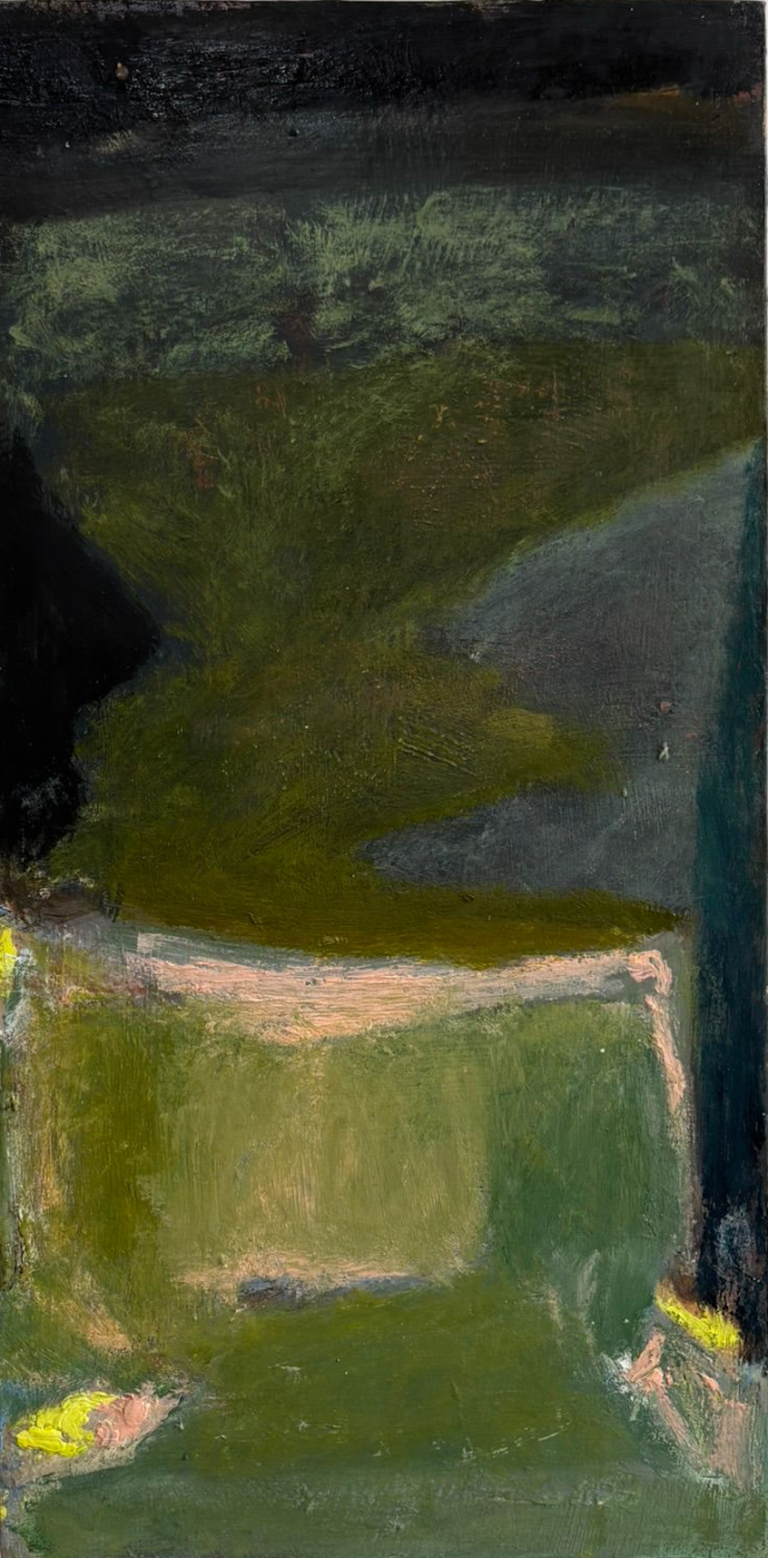
Several artists on our roster were born in these two cities, according to their artist pages. From Guadalajara come Ricardo Luévanos, born in 1985, a multidisciplinary and mixed media artist, and Karlos Ibarra, born in 1995, a painter. From Monterrey come Pepe Reyes, born in 1980, who works in collage, and Fernanda Rivero, born in 1983, whose Full Moon is pictured above. Chuma Montemayor, whose show is now at the Fototeca Nuevo León, is also represented by Art of NOMA; our spotlight on Chuma Montemayor looks at the photographs.
The same circuit continues across the region. Our overview of Latin American art fairs lists the fairs by date, and our city guides to ARTBO in Bogotá and Pinta Lima follow the same method as this one.
You can browse every original on our works page. The lowest price on the live catalogue today is MX$ 2,358, shown for a limited-edition print, and prices change, so check each work page.
Verified 29 October 2026 against museocabanas.jalisco.gob.mx (home, history and exhibition pages), marco.org.mx (visit page and both exhibition pages), material-fair.com (Estación Material, Vol. 5 and Feria Material, Vol. 12), travesiacuatro.com (contact page), conarte.org.mx (home and the news pages on “Esperando el impacto” and VISOR), our artist pages and the live listings of the works shown on artofnoma.com.
Frequently Asked Questions
Is the Museo Cabañas free on any day?
Yes. The museum lists Tuesday as free admission. On other days general admission is MX$160, and the museum opens Tuesday to Sunday, 10:00 to 17:00.
When is MARCO in Monterrey free?
MARCO is free for the general public on Sunday, and free on Wednesday for students and teachers with valid ID. General admission is otherwise MX$150.
What is Estación Material?
It is the Guadalajara fair run by Material, held at Plataforma in Colonia Americana. Its fifth edition ran from 24 to 27 September 2026 with 18 galleries and spaces from across Mexico.
Where can I see Chuma Montemayor’s work in Monterrey?
At the Sala de Proyectos of the Fototeca Nuevo León, in Nave I of the Centro de las Artes in Parque Fundidora, where “Esperando el impacto” is on view free of charge until February 2027.